


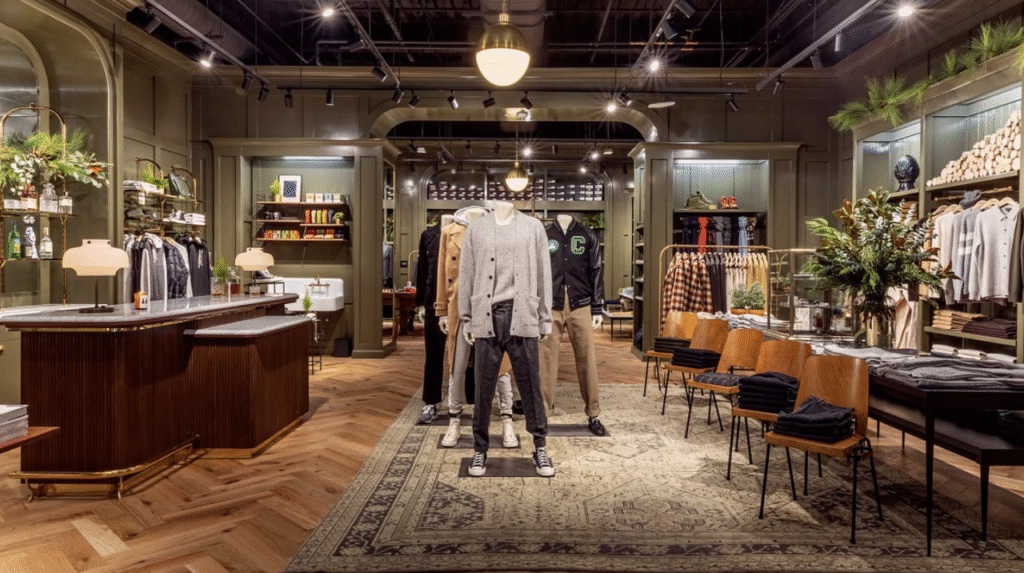
Every couple of years, it seems like physical retail is dead. Online sales tick up, a handful of stores go under, and the narrative is easy to write. The nuance those stories miss is that it’s not the right type of stores going under – big, undifferentiated, slow, price- and selection-based competitors to the internet. Independent boutiques play a different game. And today, many are winning that game against their digital peers on the metrics that count: margin, customer retention, and the cost of new customer acquisition.
The sensory deficit that e-commerce can’t solve
Some product categories are suitable for online retail. Books, electronics, everyday household items – they involve situations where customers know exactly what they need, and finding products usually comes down to price. Other products involve your body, emotions, and the moment. Jewelry is one such product category.
No product image on a computer screen tells you how a gold band feels in your hand, how a diamond captures light from a particular angle, or if the color of a stone complements your skin tone. These are not things that a well-exposed product picture immediately clarifies. These are physical, sensory, and completely individual aspects. The same goes for fitting on a piece of clothing, choosing a perfume, or picking a piece of art that you plan to hang in your home.
In big-involvement, big-money purchases – those that people regularly spend weeks or months researching – the physical shop is frequently where that decision gets made.
If you’re researching an engagement ring or some kind of fine jewelry for a big event, the customer will feel exponentially more comfortable and informed visiting a jewellery shop joondalup and firsthand collaborating with a master jeweler than they ever could slightly zooming into vague product images on a global retailer’s website. The discussion that happens in that store – regarding quality, sourcing, set options, your own tastes – is something no computer code has yet matched.
The cost of “frictionless” and the value of friction
Over the last decade, major digital players have optimized around reducing all friction from the buying process. One click, remember my details, done. Their ambition is to take away any possible barrier between someone’s desire to buy something and the completion of that purchase. That all makes perfect sense if you have made up your mind, and you’re just deciding which matching item to choose.
But in a low-friction environment, no one asks what the ring is for. No one sees that you’re wavering and gently recommends a different stone. No one senses you’re uncertain and offers you a seat, or a coffee, or the reassurance that comes from talking to someone who has sold hundreds of these and knows exactly what questions to ask.
What successful independents create is “positive friction.” A member of staff who leads you to the right question. A space where you’re not going to be hurried into making a decision in the next thirty seconds. The cold beer, the comfy chair, the conversation that flows into personal territory. This isn’t waste. This is productive relationship-building, creating higher average orders, lower returns, more loyal customers. The slow shopping trend and the rise of the so-called “experiential retailer” are simply ripples of the lake created by that pebble in the water: more people are looking for more friction and less process.
Hyper-local presence as a community asset
The best independent retailers no longer think of their stores as just a place to buy things, but rather as a hub of the community. This is evident in how they use their physical space when sales are not taking place.
VIP preview nights for new collections, workshops where local designers or artisans explain their process, styling sessions by appointment – these events don’t directly generate revenue in the moment, but they build the kind of loyalty that advertising can’t buy. When a customer remembers that your store is where they learned something, or celebrated something, or brought a friend who ended up buying something unexpected, that store has become part of their life. That’s a competitive position no e-commerce platform can occupy.
Hyper-localization matters here too. A boutique that knows its neighbourhood – the local events, the demographic shifts, what people in this particular area actually want – can curate an inventory that feels personally relevant in a way that no algorithm-driven product feed achieves. Endless digital aisles are often experienced as overwhelming rather than abundant. A carefully chosen selection of fifty or a hundred items, all of which feel right for this specific place and customer base, is a service in itself.
Clienteling versus the mass email blast
If you ask a regular customer of a small boutique what makes them keep going back, you’ll hear a version of the same answer over and over: “They know me.” This doesn’t mean that some vaguely intelligent online backend has surfaced items similar to your last order. It means that a particular person at the shop remembers that you bought a gift for your anniversary, a dress you liked, mentioned you were obsessed with a certain designer, or even just shot you a quick email to let you know that item you’d been coveting hit the shelves.
This is clienteling. It’s the practice of cultivating real, personal relationships with actual customers, based on a true knowledge of their tastes and past history – rather than, say, just pressing send on the weekly email newsletter to thirty thousand people.
The technology isn’t necessarily high-tech. It could be as simple as a note scrawled in a basic customer file, a personal cell phone text message, a quick ring to let you know that item came in. It’s not about the tech – it’s about the motivation. Mass online retailers, by definition, cannot work this way. It’s one of the last aspects of retail where smaller can actually be a sustainable advantage.
Digital acquisition costs and why your storefront is a billboard
Paying for ads on major social platforms has gotten a lot pricier in recent times. Customer Acquisition Cost – the amount a business shells out to reel in one new customer – has shot up for all but a small number of product sectors. For small e-commerce brands competing against larger players with bigger ad budgets, this creates a structural disadvantage that compounds over time.
What doesn’t factor into that cost of acquisition? Your bricks and mortar location. A good, obvious retail space can generate that kind of awareness day-in, day-out, without a cost-per-impression. People walk past. People mention it to friends. A striking window display during the school run reaches dozens of potential customers without a single dollar in ad spend. The store itself is a form of media.
When you couple that local organic visibility with a profile of local SEO best practices – appearing in map searches for meaningful keywords, ensuring that your business’ info is kept up to date and uniform across all platforms, gently encouraging customers to leave genuine positive reviews – the cost-per-acquisition for a well-run boutique in select categories starts to compare quite favorably to any digital-native competitor’s numbers. The physical footprint and the digital footprint enhance and amplify each other, and neither works quite as well on its own.
Handling showrooming without panic
Showrooming is a phenomenon where customers first visit a brick-and-mortar store to check out the product and then purchase it online from home often for a cheaper price. While showrooming is a reality, it’s often exaggerated as a threat. The stores that are having the most difficult time with it are the ones selling generic, mass-produced products that are easily found elsewhere. The answer, in that case, isn’t to try to beat Amazon on price. The answer is to sell things that Amazon can’t.
That means inventory that is exclusive and not available through typical mass retail channels. It means in-store perks that add value to the product (such as customization or expert tailoring). It means offering lifetime care, sizing adjustments, or restoration services that transform a one-time purchase into an ongoing relationship. If the value isn’t in the product itself, but rather in the service, the relationship, and the uniqueness of the choice, all of a sudden the price isn’t as important.
Artisanal goods and small-batch products with genuine provenance stories are particularly resistant to showrooming. Customers who care about how something was made, and by whom, are often looking for reasons to buy locally – not reasons to defect.
The phygital blueprint that actually works
The local independent retailers that keep growing year after year tend to follow one simple hybrid principle: let digital bring local customers to your door, then win them over face to face. Which is the opposite of what most “online” businesses are trying to pull off.
For a physical boutique, the digital touchpoints that carry the most weight are fairly narrow. A strong local search presence. Social media that shows what the shop actually looks and feels like, including the people behind the counter. And a quick, painless way for customers to ask questions over DM or a private channel and get a real answer. Together, these feed a habit that’s now completely normal among shoppers: researching a purchase online, then heading to a specific store to buy it. The industry calls it webrooming.
The operational side used to be the hard part, but modern POS systems have closed much of that gap. Stock levels customers can see online, bookable consultation slots, digital receipts tied back to customer profiles. None of it demands enterprise-level spend. What it does demand is picking a handful of lightweight tools and actually sticking with them.
The ethics argument is also the business argument
Consumers who are aware are becoming more inquisitive about the origin of products, the packaging, and the entire supply chain. A boutique that has a very obvious local connection, sourcing from local or regional producers, and does not produce the packaging waste associated with express deliveries, will easily enter this discussion.
Jewelry seems to be a product that we care much more about the origin of. Clients interested in knowing where a stone was mined, how a piece was finished, or who the artisan was, will not be satisfied when shopping from a faceless online marketplace. They will only be satisfied when talking to a jeweler who can give them all the details about where the piece came from and how it was produced. In this case, transparency is not a claim, it is a value.
The retail apocalypse never occurred for independent boutiques that were aware of their own value. It only happened to stores that attempted to compete under conditions set by someone else. Those that focused on the real strengths of physical retailing – human connection, craftsmanship, building a community, and the presence experience – discovered that the internet had not killed their market. It had, in a strange way, actually made it stronger.