How to Choose the Right Truck Jack Stand for Full-Size Pickups and Semi-Trucks in the US

Working underneath a truck — whether it is a full-size pickup sitting in a private garage or a Class 8 semi parked at a commercial fleet yard — is not a task that tolerates guesswork. The equipment holding a vehicle off the ground during service carries the full weight of that decision, and in shops where trucks cycle through regularly, that equipment is used hard and used often. Yet jack stands remain one of the most inconsistently selected items in a professional service environment. Technicians and fleet operators frequently inherit whatever stands are already on the floor, or purchase based on price alone, without accounting for the real differences in how these tools perform across vehicle types, weight classes, and working conditions.
Choosing the right jack stand for a truck is not complicated, but it does require understanding what separates one type from another — and what that difference means when a three-quarter-ton pickup or a loaded semi frame is resting on it for hours at a time.
Understanding Truck Jack Stand Ratings and Why They Matter for Heavy Vehicles
A truck jack stand is rated by its capacity — the maximum load it is designed to support safely under static conditions. However, the number printed on the stand is not the only figure that determines whether a stand is appropriate for a given job. The way that capacity is distributed across the stand, how the base contacts the floor, and how the locking mechanism holds under load all contribute to whether a stand performs reliably or introduces risk during service work.
For anyone working across a range of truck types, using a well-organized Truck Jack Stand guide to cross-reference rated capacity with vehicle class is a practical starting point before purchasing or stocking stands for a commercial shop or fleet operation.
Full-size pickups — half-ton, three-quarter-ton, and one-ton configurations — vary considerably in their gross vehicle weight and axle loads. A standard passenger car stand rated for a modest capacity may technically support the weight of a light pickup at one point, but it is not designed for the uneven loading, height requirements, or frame geometry that trucks present. Semi-trucks, by contrast, involve axle weights that place them in an entirely different equipment category, requiring stands built for industrial use and certified to corresponding load standards.
Static Versus Dynamic Load Considerations
When a truck is lifted and placed on stands for maintenance, the load is not perfectly even or perfectly still. Technicians move around beneath the vehicle, components are removed and reattached, and the weight distribution across support points shifts incrementally. A stand that is rated accurately for static load may behave differently when those subtle variations occur over a long service window. This is particularly relevant in commercial settings where a truck may remain elevated for an extended period during transmission work, suspension replacement, or axle servicing. The structural integrity of the stand — the quality of the casting or fabrication, the fit of the locking pin or ratchet mechanism — determines whether it holds consistently through those conditions or whether it introduces movement that should not be there.
Height Range and Truck Frame Clearance
Trucks sit higher off the ground than passenger vehicles, and the usable lift height of a jack stand must accommodate that. A stand that maxes out at a height suited for sedan work will not reach the support points on a raised pickup frame. For semi-trucks, the working height requirements are greater still. Before selecting stands for a shop that services trucks regularly, confirming that the maximum extension of the stand matches the actual working height needed — with some margin remaining — is a basic but frequently overlooked step. Stands used near their maximum extension with no margin are more prone to instability, and that risk compounds when the floor surface is not perfectly level.
Structural Differences Between Stands Designed for Pickups and Those for Commercial Trucks
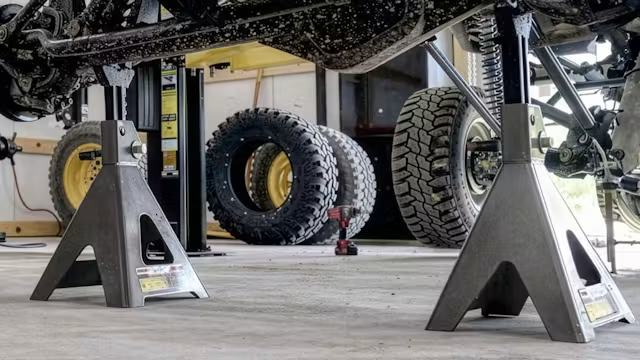
The physical construction of a jack stand built for full-size pickups differs meaningfully from one designed for commercial truck use. Pickup-rated stands are typically made from fabricated steel or ductile iron castings, with tripod or four-leg base configurations that distribute load across a moderate footprint. Commercial and semi-truck stands use heavier base construction, wider footprints, and locking systems that are designed for higher load tolerances and longer duty cycles. Using pickup-rated stands under a semi-truck, even at comparable axle points, introduces a margin of risk that is not visible until a failure occurs.
Base Design and Floor Contact
The base of a jack stand is its primary connection to the surface it rests on, and the design of that base affects stability in ways that go beyond raw capacity. A wide base with flat contact points distributes load more evenly across the floor surface. Narrow or pointed base configurations may concentrate load in a way that causes the stand to shift on smooth concrete or coated shop floors — a common surface in modern service facilities. For trucks with high centers of gravity and uneven weight distribution during service, base stability is not a secondary concern. It is a core functional requirement of the stand itself.
Ratchet Versus Pin-Lock Mechanisms
Jack stands are typically secured at height using either a ratchet-style adjustment or a pin through a series of height slots. Each system has trade-offs. Ratchet mechanisms allow for incremental height adjustment and are generally faster to set, but they require the ratchet teeth and pawl to remain in good condition to hold reliably. Pin-lock systems are mechanically simpler and can be more predictable when the stand is in good repair, but they offer fewer incremental height positions. In a high-volume shop, the maintenance condition of the locking mechanism matters more than the design type — worn ratchet teeth or bent pins on heavily used stands are a common source of stand failure that often goes unnoticed until a problem occurs.
How Truck Type and Service Task Should Influence Stand Selection
Not every truck service task places the same demands on a jack stand, and not every truck within the same category sits or loads the same way. A diesel-powered one-ton dually used for commercial towing carries significantly more mass than a standard half-ton configured for light use, even though both fall under the general label of full-size pickup. Similarly, a semi tractor sitting without a trailer at a maintenance facility presents different support points and weight distribution than one that has had its fifth wheel loaded. Matching the stand to the actual service context — rather than to a broad vehicle category — reduces the margin for error.
Axle and Frame Support Points on Full-Size Pickups
Full-size pickups, particularly those with heavy-duty suspensions, solid rear axles, or aftermarket lift equipment, require attention to where the stand contacts the vehicle. Manufacturer-specified support points are defined in service documentation and exist because the frame and underbody of the truck are engineered to accept load at those locations without deforming. Placing a stand under a location that is not designed for point loading — even if it seems structurally solid — can cause damage that is not immediately visible and may compromise the truck’s structural performance over time. According to the Occupational Safety and Health Administration, proper support of vehicles during service is a defined safety requirement in automotive and fleet service environments, and failure to follow manufacturer-specified lift points is a recognized contributing factor in service-related incidents.
Commercial Truck Support During Extended Service Windows
Semi-trucks undergoing major service — engine pulls, differential work, or frame-level repairs — may remain elevated on stands for days rather than hours. During that time, the stands are subject to sustained static load, temperature variation in the shop environment, and incidental contact from equipment and personnel moving through the work area. Stands selected for commercial truck service should be rated well above the expected load, maintained in documented condition, and positioned on surfaces that are confirmed level before the truck is lowered onto them. Commercial fleet operations that manage their own maintenance programs typically designate specific stands for specific vehicle classes rather than sharing equipment across all jobs indiscriminately.
What to Look for When Evaluating Jack Stand Condition and Replacement Intervals
Jack stands do not have a manufacturer-recommended replacement interval in the same way that consumables do, but they do degrade with use. Welds fatigue, locking mechanisms wear, base surfaces develop cracks or deformation, and protective coatings break down in shop environments exposed to fluids, temperature fluctuation, and heavy use. A stand that appears serviceable to a casual inspection may have accumulated stress that is not visible on the surface but affects its ability to hold safely under load.
Inspection Practices That Reduce Risk
A practical inspection before each use covers the primary failure points: the locking mechanism for wear or deformation, the base for cracking or warping, the contact saddle for damage that could cause slipping, and the overall structure for any visible weld failure or bending. In commercial settings, stands that show any of these signs should be removed from service rather than kept in use while a replacement is sourced. The cost difference between replacing a stand and managing the consequences of a failure during service is not a close comparison.
Closing Considerations for Shops and Fleet Operators
Selecting the right truck jack stand comes down to matching rated capacity and physical design to the actual demands of the work being done — not to a general category of vehicle or a budget line. Full-size pickups and semi-trucks present different weight classes, different support geometries, and different service durations, each of which affects what a stand needs to do reliably over time.
For shops that service both pickup trucks and commercial vehicles, maintaining separate stand inventories rated appropriately for each category is a straightforward way to reduce the risk of misapplication. For fleet operators managing their own maintenance, establishing a documented inspection and replacement protocol for stands ensures that equipment condition does not quietly become a liability.
The choices made around support equipment tend to receive less attention than the tools used to perform the service itself, but they carry consequences that are equally significant. A truck correctly diagnosed and properly repaired is still a risk if the stand holding it during that work was not appropriate for the job. Getting that decision right before work begins is the simpler and more reliable approach.