
How AI Helps Renovation Companies Win More Projects and Boost Profit

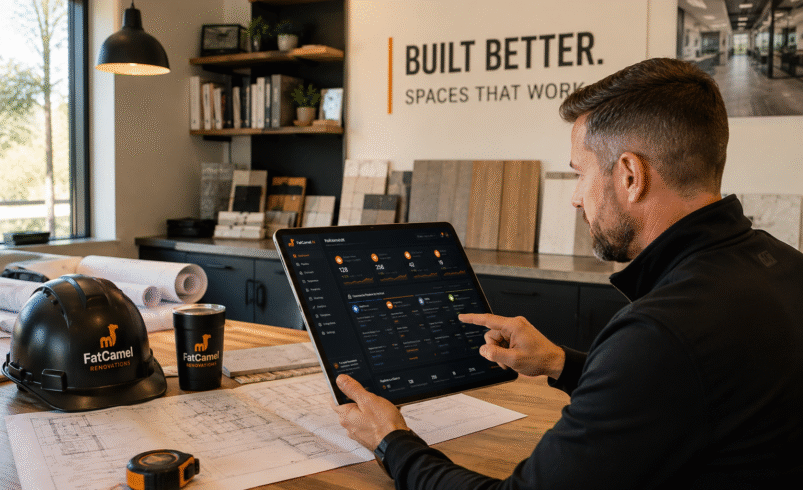
The renovation industry runs on craftsmanship, trust, and strong customer relationships, and that hasn’t changed. What has changed is how homeowners choose a contractor. Today’s customers expect instant replies, transparent communication, accurate estimates, and a smooth experience from their first inquiry through the final walkthrough.
Meeting those expectations while juggling multiple job sites isn’t easy. Between answering calls, chasing leads, drafting estimates, booking site visits, ordering materials, and managing crews, renovation business owners often spend more time on admin work than on growing the business.
That’s where artificial intelligence comes in.
AI isn’t replacing contractors, designers, or project managers. It’s a digital assistant that automates repetitive tasks, sharpens customer communication, and helps renovation companies run more efficiently, whether you’re a small remodeling outfit or an established renovation firm looking to scale.
Why AI Matters for Renovation Businesses
Many renovation companies lose revenue for reasons unrelated to the quality of their craftsmanship. The work itself might be excellent, the crew reliable, and the finished product beautiful, yet the business still loses winnable projects because of small operational breakdowns that happen behind the scenes for renovation ai tools.
A homeowner submits a quote request at 9 PM but doesn’t hear back until the next afternoon. By then, they’ve already booked consultations with two competitors. An estimator forgets to follow up after sending a proposal, and the homeowner assumes the company isn’t interested anymore. A project manager spends hours fielding routine questions about paint colors or delivery windows instead of supervising an active job site, and small issues on site go unnoticed a little longer than they should.
These everyday operational gaps quietly cost renovation businesses real opportunities, often without the owner ever realizing exactly where the leads went. AI closes those gaps by automating routine administrative work, catching the inquiries that would otherwise sit unanswered overnight and keeping every prospect moving through the pipeline. That frees your team to focus on what actually grows the business: building great spaces and serving customers well.
Respond to Every Lead Within Seconds
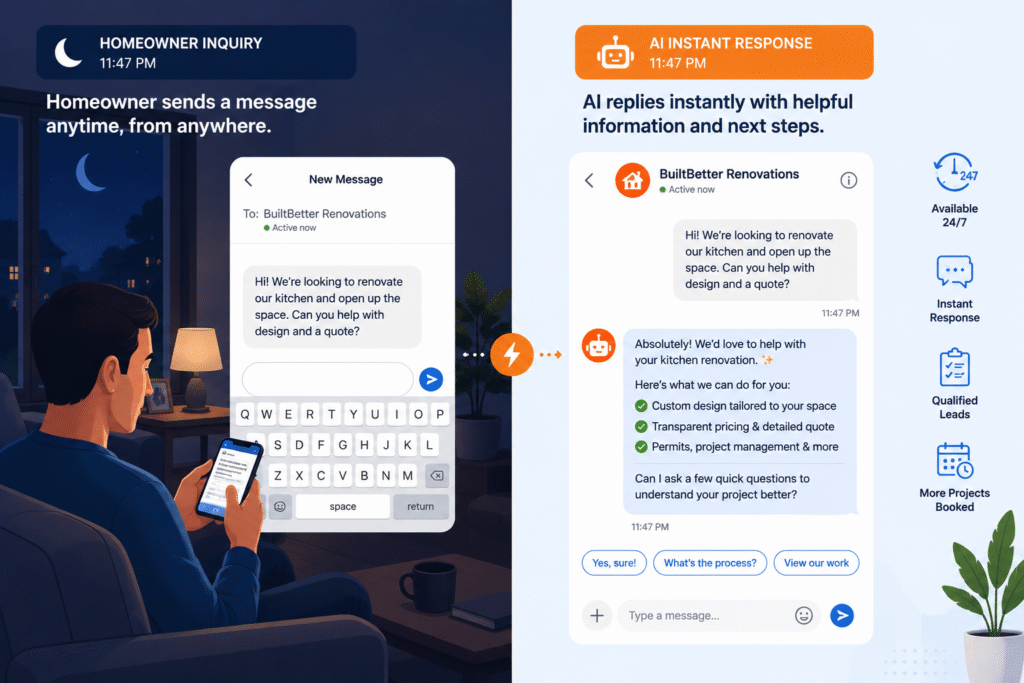
Speed wins deals. Businesses that respond to inquiries quickly are significantly more likely to convert prospects into paying customers, yet many renovation companies still rely on manual responses only during business hours.
AI-powered chatbots and virtual assistants engage website visitors instantly, including evenings, weekends, and holidays. Instead of waiting for someone to return to the office, potential customers get immediate answers to common questions, and the AI can collect project details, qualify the lead, schedule a consultation, share expected timelines, and route the conversation to the right team member, all in the same interaction.
The result: a better first impression and fewer missed opportunities.
Automate Lead Qualification
Not every inquiry is worth pursuing. Some homeowners fall outside your service area; others have budgets that don’t match your services or need work outside your expertise entirely. Chasing every single lead with the same level of effort spreads a small sales team thin and pulls attention away from the prospects who are genuinely ready to move forward.
Rather than having your sales team manually filter every lead, AI can gather key details upfront, including the type of renovation being planned, which rooms are involved, the homeowner’s estimated budget, the desired start date, and the property location. This qualification happens automatically during the very first conversation, long before a person on your team ever picks up the phone. Qualified leads are then automatically prioritized and routed to the right estimator, so your team spends time on the projects most likely to close instead of manually sorting through every form submission by hand.
.
Never Forget a Follow-Up
Many renovation projects take weeks or even months of consideration before a contract is signed. Homeowners often collect two or three quotes, discuss the decision with a spouse or family member, and revisit their budget before committing. Unfortunately, commercial renovation contractors often lose jobs simply because follow-ups slip through the cracks somewhere during that longer decision window, not because the estimate or the workmanship was ever in question.
AI can automate personalized follow-up sequences by email and SMS, thanking customers after a consultation, reminding homeowners to review a proposal, confirming appointments, checking in after an estimate goes out, reconnecting with prospects who’ve gone quiet, and requesting reviews once a project wraps up. Each message can be timed and personalized based on where the customer is in the decision process, so it feels like attentive service rather than a generic reminder. Consistent, automated communication keeps your company top of mind without adding to your daily workload, and it often nudges an undecided homeowner back into the conversation right when a competitor’s name has started to fade.
Produce Estimates More Efficiently
Preparing renovation estimates takes experience and careful review, but much of the process is repetitive.
AI can help organize customer information, summarize project requirements, suggest proposal templates, and generate draft estimates based on historical project data. Experienced professionals still verify pricing and scope, but AI significantly cuts down administrative effort and turnaround time.
Faster estimates mean a better customer experience and a stronger chance of winning the job before competitors even respond.
Simplify Appointment Scheduling
Booking site visits often means multiple phone calls, emails, and calendar adjustments, especially when a homeowner’s schedule doesn’t line up neatly with your estimator’s availability. Each round of back and forth adds another day or two of delay before the project even gets started, and some homeowners simply give up and book with whichever company got them on the calendar first.
AI scheduling assistants remove that friction by integrating directly with your calendar, letting customers choose an available time, receive an automatic confirmation, get reminder messages as the date approaches, and reschedule easily if plans change without needing to call the office. Less scheduling friction means fewer missed appointments and a smoother customer journey from the very first meeting, which sets a confident tone for the rest of the project relationship.
Improve Customer Communication Throughout Projects
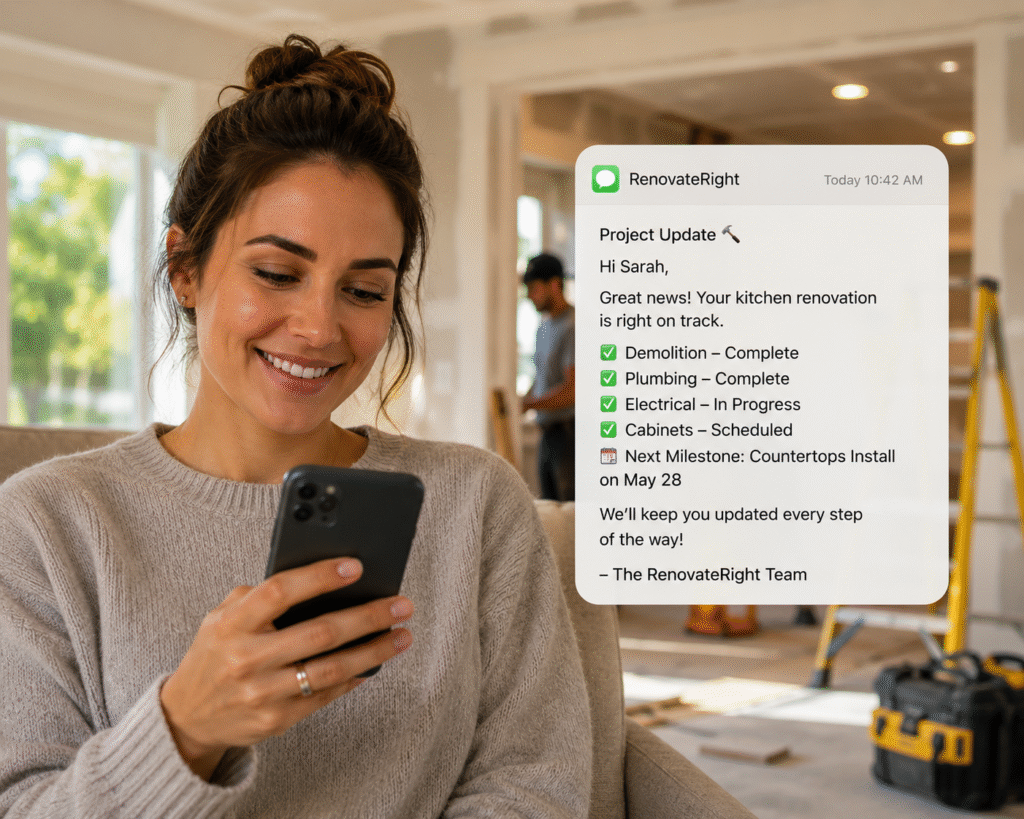
Homeowners value regular updates. In fact, poor communication is one of the most common renovation complaints, often outranking concerns about workmanship itself. A project can be running exactly on schedule, but if the homeowner hasn’t heard anything in a week, they start to worry, and that anxiety often turns into a phone call your office has to handle.
AI can automatically send project start notifications, daily or weekly progress summaries, material delivery updates, appointment and payment reminders, and milestone alerts as work reaches completion, all without anyone on your team having to remember to send them. Keeping customers in the loop builds trust and cuts down on unnecessary calls to your office, freeing up staff time while also making the homeowner feel genuinely looked after throughout a process that can otherwise feel uncertain and drawn out.
Support Better Project Management
AI doesn’t replace experienced project managers. It helps them stay organized in a job that naturally involves dozens of moving pieces at once: subcontractor schedules, material deliveries, permit timelines, and constant communication across every stakeholder on a project. Modern AI tools can track project timelines, organize documentation, assign tasks, monitor deadlines, summarize meeting notes, and manage communication across teams, keeping everything in one place instead of scattered across texts, emails, and sticky notes. With less administrative burden, project managers can spend more time overseeing quality and solving problems on-site, which is ultimately where their experience matters most and where AI simply can’t substitute for human judgment.
Strengthen Your Marketing
Winning more renovation projects requires consistent visibility, but many contractors struggle to maintain an active online presence because marketing takes time that’s already stretched thin across estimates, site visits, and crew management. Content creation is often the first thing to slip when the business gets busy, which ironically is exactly when consistent marketing matters most.
AI can speed up content creation by helping generate blog articles, service pages, social media posts, customer success stories, email newsletters, FAQs, and Google Business Profile updates, giving your team a draft to refine rather than a blank document every time. Content should always be reviewed for accuracy and brand voice before it goes live, but AI dramatically cuts the time needed to produce valuable marketing material, and consistent content improves search visibility and generates qualified leads over time, even during the busiest stretches of the renovation season.
Analyze Business Performance
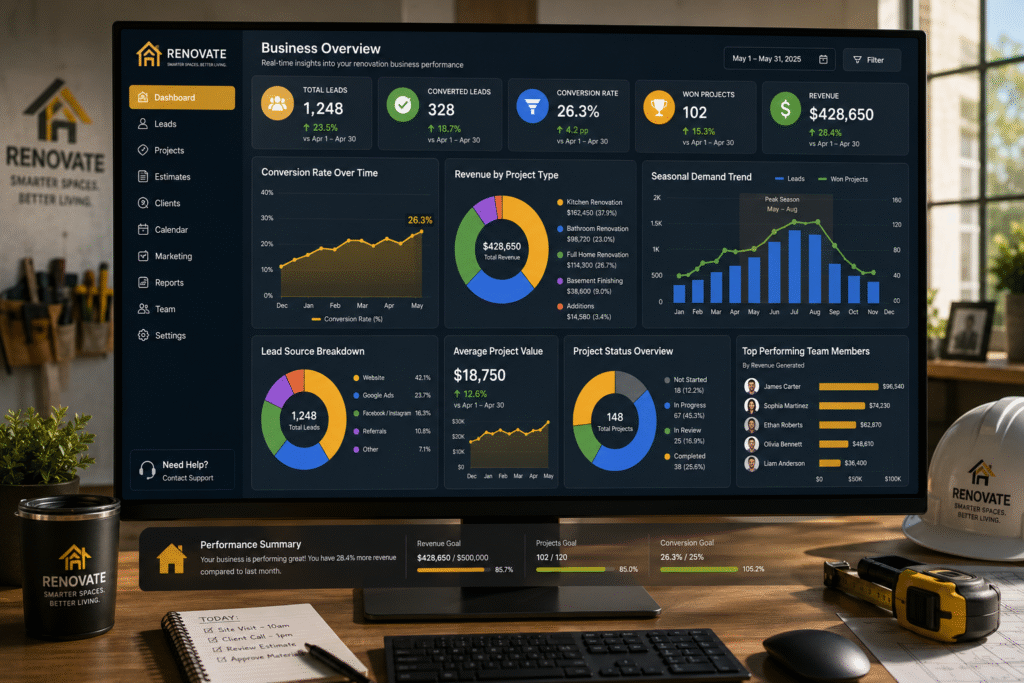
Successful renovation companies make decisions using data, not guesswork, especially when it comes to deciding where to invest marketing dollars or which crew to expand first. AI-powered analytics can surface trends in average response time, lead conversion rates, the most profitable project categories, seasonal demand patterns, customer acquisition costs, marketing performance, and team productivity, pulling all of it into a single view instead of leaving it scattered across spreadsheets and separate tools. These insights help owners allocate resources more effectively and make smarter growth decisions, whether that means doubling down on kitchen remodels during a slow season or investing more heavily in the lead sources that actually convert.
Reduce Administrative Costs
Administrative work eats up hours that could otherwise generate revenue, and it’s rarely the reason anyone got into the renovation business in the first place. AI can automate repetitive tasks including data entry, CRM updates, invoice reminders, document organization, internal notifications, customer communication, and appointment confirmations, reducing manual work and improving operational efficiency without increasing payroll. For a growing renovation company, that often means avoiding the need to hire an additional office coordinator just to keep up with paperwork, freeing that budget for crews, equipment, or marketing instead.
Deliver a Better Customer Experience
The renovation companies that stand out today don’t just deliver beautiful spaces. They deliver an exceptional experience from start to finish, and homeowners notice the difference even before the first wall comes down. A smooth, well-communicated project tends to earn just as much loyalty as the finished result itself.
AI helps create that experience through faster responses, clearer communication, reliable scheduling, consistent follow-ups, accurate information, and personalized interactions at every stage of the relationship. Satisfied customers are more likely to leave positive reviews, refer your business to friends and neighbors, and return for future projects when it’s time to renovate another room, which investing in a smoother customer journey pays off well beyond any single job.
Common Misconceptions About AI

Some renovation business owners hesitate to adopt AI, assuming it’s expensive, complicated, or built only for large companies with dedicated IT departments and big software budgets. That assumption often keeps smaller, more agile companies from picking up an advantage their larger competitors are already using.
In reality, many AI-powered tools are affordable, easy to implement, and designed specifically for small and medium-sized businesses, often with setup that takes a matter of hours rather than weeks. AI isn’t meant to replace your expertise or personal relationships. It removes the repetitive tasks that eat up valuable time, leaving the relationship-building and craftsmanship to the people who do it best. Think of AI as another member of your team: one that works around the clock without getting tired, never calls in sick, and handles the follow-ups everyone else keeps meaning to get to.
The Competitive Advantage of Early AI Adoption

As homeowners increasingly expect immediate service and digital convenience, renovation companies that embrace AI gain a real edge over those still operating the old way. They respond faster, follow up more consistently, communicate more effectively, and manage projects more efficiently, and homeowners feel that difference from the very first interaction. Meanwhile, companies relying entirely on manual processes risk losing projects before a conversation even starts, simply because a competitor answered the inquiry first and kept the homeowner engaged.
Early adoption doesn’t require a full operational overhaul. Even one or two AI-powered workflows, like instant lead response or automated follow-ups, can produce measurable gains in efficiency and customer satisfaction within the first few months, making it easy to build momentum before rolling out additional tools.
Final Thoughts
Artificial intelligence is becoming an essential tool for renovation companies looking to grow in an increasingly competitive market. By automating routine tasks, improving customer communication, streamlining operations, and delivering valuable business insights, AI lets contractors focus on what matters most: delivering outstanding renovation projects and building the kind of reputation that generates repeat business and referrals for years to come.
The future of the renovation industry won’t be defined by AI replacing skilled professionals. It will be shaped by businesses that use AI to enhance their expertise, strengthen customer relationships, and operate more efficiently, letting the people who actually build and manage renovations spend less time on paperwork and more time doing the work that made customers choose them in the first place.
For renovation companies aiming to win more projects and boost profitability, AI isn’t just a trend. It’s quickly becoming a competitive advantage no forward-thinking business can afford to ignore, and the companies that start building these workflows now will be the ones setting the pace for the rest of the industry.
Frequently Asked Questions
1. How can AI help my renovation company get more leads?
AI-powered chatbots and virtual assistants respond to website inquiries instantly, 24/7, so you never lose a lead to slow response times. They can also qualify leads automatically, ensuring your sales team spends time on the prospects most likely to convert.
2. Is AI expensive to implement for a small renovation business?
Not necessarily. Many AI tools are subscription-based, scalable, and built specifically for small and medium-sized contractors. Most companies start with one workflow, like lead response or follow-up automation, and expand from there as they see results.
3. Will AI replace project managers or estimators in the renovation industry?
No. AI handles repetitive administrative tasks like data entry, scheduling, and status updates, but it doesn’t replace the judgment, experience, and hands-on decision-making that estimators and project managers bring to a job site.
4. Can AI actually write accurate renovation estimates?
AI can speed up the estimating process by organizing project details and generating draft estimates based on historical data and templates, but a qualified professional should always review and finalize pricing and scope before it goes to the customer.
5. What’s the easiest AI workflow for a renovation company to start with?
Instant lead response and automated follow-ups are usually the easiest starting points. They require minimal setup, integrate with most CRMs, and deliver a fast, measurable return by reducing missed opportunities.
6. How does AI improve communication during an active renovation project?
AI can automatically send homeowners progress updates, material delivery notifications, appointment reminders, and payment reminders, reducing the back-and-forth phone calls that often frustrate both customers and office staff.
7. Do I need technical expertise to use AI tools in my renovation business?
No. Most AI tools built for contractors are designed with simple, no-code interfaces that integrate with the software you already use, such as your CRM, calendar, or website. Most setups can be handled without hiring a developer.