
FAA, Microsoft and United Airlines outages expose the growing risks of aging IT infrastructure

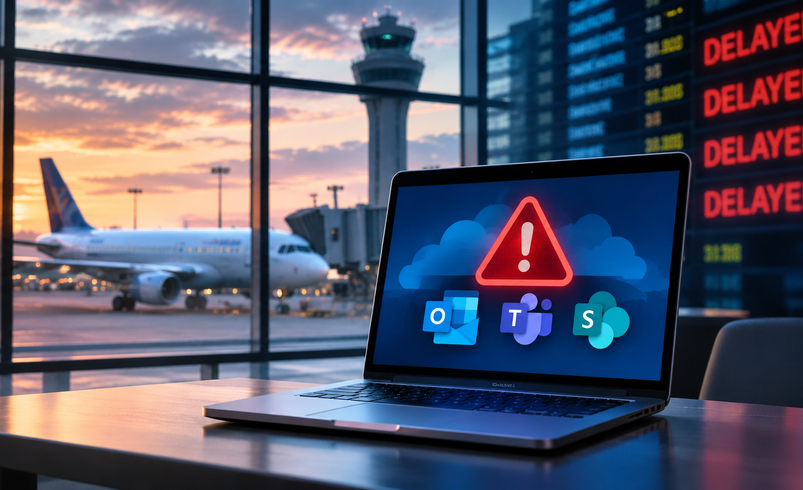
A series of major technology failures across the United States in November 2026 has demonstrated how quickly operational problems can spread when essential business functions depend on interconnected systems. Within five days, the Federal Aviation Administration (FAA) issued a nationwide ground stop, Microsoft experienced a significant Microsoft 365 disruption, and United Airlines temporarily delayed departing flights because of a technology outage. Although these incidents involved different systems and organizations, they exposed a common business challenge: Critical operations can become vulnerable when infrastructure dependencies, software changes, and recovery procedures are not adequately managed.
The disruptions affected aviation, enterprise communications, and cloud-based productivity services, creating consequences beyond the technical systems where the problems originated. Importantly, these incidents were not established as cyberattacks. They demonstrate why organizations must address infrastructure reliability, operational resilience, and business continuity alongside cybersecurity.
For business executives, the lesson is not that every technology failure can be prevented. Rather, infrastructure visibility, disciplined change management, proactive maintenance, and tested recovery procedures are essential to maintaining reliable operations.
FAA nationwide ground stop reveals the risks of legacy infrastructure
On November 13, 2026, the FAA experienced a technical failure that resulted in a nationwide ground stop beginning at approximately 3:30 p.m. Eastern Time. According to the agency’s official explanation, instability developed within its telecommunications infrastructure when excessive data traffic overwhelmed parts of the FAA Telecommunications Infrastructure network, commonly known as FTI. The disruption affected the stability of communications and radar feeds used by air traffic controllers, prompting the agency to halt departures while engineers investigated the problem.
The FAA reported approximately 1,000 connection attempts every four to five seconds. Its preliminary investigation identified two possible sources of excessive traffic: A radar site in Amarillo, Texas, and a radio communications facility in El Dorado, Arkansas. Network service provider L3Harris had been performing work at the Arkansas location, including deploying a new router. Engineers isolated suspected sources, adjusted affected network functionality, and restored stability before air traffic operations resumed at approximately 8:15 p.m.
The operational consequences were substantial. The FAA reported approximately 12,462 flight cancellations on November 13, although the agency cautioned that not every cancellation was directly attributable to the ground stop. It also paused additional installations of the affected Juniper routers while investigating the underlying technical problem.
The incident illustrates how infrastructure changes can create unexpected consequences when new equipment interacts with established systems. For organizations operating complex technology environments, replacing a network device requires understanding existing architecture, traffic behavior, compatibility requirements, and the operational dependencies that could be affected.
Microsoft’s November 12 outage demonstrates cloud dependency risks
Just one day before the FAA disruption, Microsoft experienced a significant service outage affecting Microsoft 365 customers. The November 12 incident interrupted access to Exchange Online and affected connectivity across services including Outlook, Microsoft Teams, SharePoint Online, Microsoft 365 Copilot, and Microsoft Defender XDR. Customers in multiple regions experienced service disruptions, demonstrating how problems within shared cloud infrastructure can affect business applications used by organizations around the world.
According to Microsoft’s incident communications, the disruption involved unexpected server unavailability, elevated infrastructure load, and problems processing connections across affected systems. Engineers worked to restore servers, redistribute traffic, adjust connection handling, and stabilize service capacity. Microsoft also examined recent configuration changes as potential contributing factors. The available incident reporting did not establish malicious activity as the cause.
Microsoft’s incident record identified November 13 at 16:10 UTC as the resolution time. The severity of disruption varied by service, region, and connection method, but the incident demonstrated how problems affecting foundational cloud components can interfere with multiple business applications simultaneously.
For organizations dependent on Microsoft 365, interrupted access can affect nearly every department. Employees may be unable to retrieve email, access shared documents, coordinate through collaboration platforms, or complete workflows dependent on cloud services. Even when an outage originates within Microsoft’s infrastructure rather than a customer’s internal environment, businesses still need procedures for communicating with employees, prioritizing critical work, and managing operational interruptions.
United Airlines experiences another major operational disruption
On November 16, United Airlines experienced a technology outage that delayed departing flights for approximately one hour and forty minutes. According to Associated Press reporting, pilots described difficulties involving systems supporting departure operations, including information related to aircraft weight and balance calculations. United confirmed that the technology problem had been resolved and stated that flights already airborne and United Express regional operations were not affected.
The airline also reported no indication of a cybersecurity-related incident. Although flight tracking services recorded hundreds of United delays that day, the precise number directly attributable to the technology failure was not established.
The outage occurred only three days after the FAA’s nationwide ground stop, providing another example of how technology disruptions affect operationally sensitive industries. Aviation systems must meet demanding safety and reliability requirements, and even temporary interruptions can require organizations to suspend activities until essential information becomes available.
For businesses outside aviation, the principle is equally relevant. Manufacturers may need to pause production when critical systems become unavailable, healthcare organizations may experience interruptions to administrative workflows, and professional services firms may lose access to information required to serve clients. Technology availability directly influences an organization’s ability to deliver services.
Why proactive managed IT services matter more than reactive support
The November disruptions demonstrate the limitations of treating IT management primarily as a response to problems after they occur. Although sophisticated organizations cannot prevent every infrastructure failure, proactive management can reduce avoidable risks, improve visibility, and establish a coordinated response when systems become unavailable.
Businesses using Managed IT services can establish a structured approach to maintaining technology environments through monitoring, patch management, network administration, Microsoft 365 support, and coordinated technical assistance. These capabilities help organizations identify developing problems, maintain supported systems, and manage technology dependencies that employees rely on throughout the business day.
However, managed IT should not be confused with a guarantee against external outages. A service provider cannot directly prevent a failure within Microsoft’s global infrastructure or control a telecommunications problem affecting a national aviation network. Its value lies in managing the customer’s environment, identifying affected services, coordinating with relevant vendors, maintaining appropriate safeguards, and supporting recovery.
This distinction is particularly important for mid-sized organizations that depend on multiple cloud platforms and technology providers but lack the internal resources to maintain comprehensive infrastructure oversight.
Legacy systems and modernization require disciplined planning
The FAA incident demonstrates why infrastructure modernization must involve more than replacing outdated equipment. Legacy environments often contain technologies developed over many years, with dependencies that may not be immediately apparent when individual components are upgraded.
A network device introduced into an established environment can affect traffic routing, communications protocols, system performance, and connected applications. Even when replacement equipment meets technical specifications, compatibility issues or unexpected traffic behavior may emerge under operational conditions.
Organizations should approach modernization through documented change management procedures that include dependency mapping, compatibility assessments, maintenance scheduling, testing, rollback planning, and post-deployment monitoring. Changes affecting essential systems should receive additional scrutiny because routine technical work can have consequences beyond the individual component being replaced.
This approach is particularly relevant to manufacturers, healthcare providers, and professional services organizations operating combinations of legacy applications, modern cloud platforms, and specialized business systems. Modernization can improve performance, security, and operational efficiency, but those benefits depend on careful implementation.
Business continuity planning must account for external technology failures
A significant challenge highlighted by the Microsoft and aviation disruptions is that organizations may experience operational interruptions even when their own systems have not been compromised. Cloud providers can experience infrastructure failures, telecommunications networks can become unstable, and critical applications can stop functioning because of unexpected technical defects.
Traditional backup and disaster recovery procedures are essential, but they do not necessarily address every form of service interruption. Restoring data from a backup may not resolve a situation where employees cannot authenticate to a cloud platform or access an external application required to complete their work.
Effective business continuity planning should identify critical systems, establish recovery priorities, document technology dependencies, and determine how essential activities can continue during temporary disruptions. Organizations should also understand which recovery responsibilities belong to internal teams, managed IT providers, cloud vendors, and other external partners.
These arrangements should be tested periodically rather than assumed to function during an emergency. Tabletop exercises, communication tests, backup restoration checks, and simulated service interruptions can reveal weaknesses before a real outage affects customers or employees.
Five IT management priorities executives should review
The November incidents provide an opportunity for business leaders to evaluate whether their existing technology management practices adequately support operational resilience.
Establish visibility across critical infrastructure
Organizations need accurate inventories of networks, servers, endpoints, cloud applications, and essential business systems. This visibility should include system dependencies, support responsibilities, maintenance requirements, and known vulnerabilities. Without an accurate understanding of the environment, technology teams may struggle to identify the source of a disruption or determine which business functions are affected.
Strengthen change management procedures
Infrastructure upgrades, software updates, and configuration changes should follow documented procedures appropriate to their operational risk. Testing, approval requirements, maintenance windows, rollback plans, and post-change monitoring help reduce the likelihood that routine technical work will produce unexpected consequences.
Review cloud service dependencies
Businesses should identify which essential processes depend on Microsoft 365, cloud hosting platforms, communications providers, and external software applications. Understanding these dependencies makes it easier to develop realistic continuity procedures and determine which services require alternative access methods or additional resilience measures.
Test recovery and communication procedures
Technology teams should periodically test their ability to restore data, recover supported systems, communicate during outages, and coordinate with external providers. Business continuity exercises should include scenarios where a critical vendor becomes unavailable because those situations may require different responses from incidents affecting internally managed infrastructure.
Define accountability for technology operations
Executive leadership should understand who is responsible for infrastructure monitoring, vendor coordination, incident escalation, and recovery planning. Clear responsibilities are especially important when multiple providers support different parts of the technology environment. Without coordinated oversight, organizations may experience delays while teams determine which vendor owns the problem or has authority to implement corrective action.
The business consequences of unreliable technology
Technology downtime creates consequences extending beyond the immediate interruption of an application or network connection. Employees may be unable to complete assigned work, customer transactions may be delayed, service commitments may be missed, and management teams may need to redirect resources toward resolving operational problems.
The financial impact varies by industry, organization size, and the systems involved. For a manufacturing business, unavailable production software may interfere with scheduling, inventory management, or equipment coordination. A healthcare provider may face administrative delays when essential information systems are inaccessible, while a professional services organization may experience interruptions to client communications and document workflows.
These consequences reinforce the importance of evaluating technology investments according to their contribution to business continuity rather than treating IT exclusively as an operating expense. Reliable infrastructure, documented processes, and responsive technical support help organizations maintain productivity while reducing avoidable operational uncertainty.
What the November 2026 outages mean for business leaders
The FAA, Microsoft, and United Airlines incidents occurred in different environments, involved different technical circumstances, and produced different operational consequences. Nevertheless, they collectively demonstrate that large-scale technology disruptions do not require malicious activity to create significant business problems.
Legacy infrastructure, software defects, network changes, and interconnected service dependencies can all contribute to outages that affect organizations beyond the original point of failure. Businesses cannot eliminate every external dependency, nor can they guarantee uninterrupted access to every technology platform they use.
They can, however, strengthen the way those dependencies are managed. Proactive infrastructure monitoring, disciplined change management, vendor coordination, tested recovery procedures, and clear executive accountability provide a more reliable foundation for business operations.
For mid-sized organizations, the priority should be establishing an IT management strategy that supports both everyday performance and operational resilience. The November 2026 disruptions demonstrate why maintaining technology is no longer sufficient on its own. Businesses must understand how their systems interact, what happens when essential services fail, and whether their organization is prepared to continue operating when technology becomes temporarily unavailable.
Sources and references
- Federal Aviation Administration, November 15, 2026. Nationwide Ground Stop: Questions and Answers.
https://www.faa.gov/newsroom/nationwide-ground-stop-questions-and-answers - U.S. Department of Transportation, November 14, 2026. Update on Restoration of Airspace Following Nationwide Ground Stop.
https://www.transportation.gov/briefing-room/icymi-us-transportation-secretary-sean-p-duffy-provides-update-restoration-airspace - Microsoft incident communications, November 12–13, 2026, reproduced by the University of Pennsylvania. Microsoft’s Incident Reports for PennO365.
https://mailservices.isc.upenn.edu/computing/email/penno365/alerts/ms-incidents.html - BleepingComputer, November 12, 2026. Massive Microsoft 365 outage disrupts Outlook, Teams, Copilot worldwide.
https://www.bleepingcomputer.com/news/microsoft/massive-microsoft-365-outage-disrupts-outlook-teams-copilot-worldwide/ - Associated Press, November 16, 2026, republished by ABC News. 1.5-hour-long system outage forces United Airlines to delay departing flights.
https://abcnews.com/amp/Business/wireStory/15-hour-long-system-outage-forces-united-airlines-138190979